Tuesday, December 26, 2006


Saturday, December 23, 2006
Mieville's Christmas

Call me childish, but I love all the nonsense - the snow, the trees, the tinsel, the turkey. I love presents. I love carols and cheesy songs. I just love Christmas™.First published in the Socialist Review in 2004. Read the rest of it here.
That's why I was so excited. And not just for me, but for Annie. Aylsa, her mum, said she didn't see the big deal and why was I a sentimentalist, but I knew Annie couldn't wait. She might have been 14, but when it came to this I was sure she was still a little girl, dreaming of stockings by the chimney. Whenever it's my turn to take Annie - me and Aylsa have alternated since the divorce - I do my best on the 25th.
I admit Aylsa made me feel bad. I was dreading Annie's disappointment. So I can hardly tell you how delighted I was when I found out that for the first time ever I was going to be able to make a proper celebration of it.
Don't get me wrong. I haven't got shares in YuleCo, and I can't afford a one-day end-user licence, so I couldn't have a legal party. I'd briefly considered buying from one of the budget competitors like XmasTym, or a spinoff from a non-specialist like Coca-Crissmas, but the idea of doing it on the cheap was just depressing. I wouldn't have been able to use much of the traditional stuff, and if you can't have all of it, why have any? (XmasTym had the rights to Egg Nog. But Egg Nog's disgusting.) Those other firms keep trying to create their own alternatives to proprietary classics like reindeer and snowmen, but they never take off. I'll never forget Annie's underwhelmed response to the JingleMas Holiday Gecko.
No, like most people, I was going to have a little MidWinter Event, just Annie and me. So long as I was careful to steer clear of licenced products we'd be fine.
Friday, December 22, 2006
Deathly Hallows
Harry Potter and the Deathly Hallows it is.
Other places where you can expect much good cheer befitting the season (what a clever girl JKR is!):
Mugglenet
JKR's own site
Police story coming up, promise. Since I'm at large, we can safely assume the story has a happy ending (which, given the people concerned, might have been in doubt).
Thursday, December 21, 2006
A Catalogue of Disasters: Prologue
I do.
So to celebrate, I am going to let everyone in on my disasters as they occur, so that if all of you lead normal lives, you can take vicarious pleasure in my series of unfortunate events.
To start with, I switched my blog to what I’ve been assured was no longer Blogger Beta. That means I can now sign in with my Google Account. Everyone has to switch eventually, I’m told. So I thought, what the heck, let’s get it over with.
Turns out that the normal sign in page has moved. After many futile attempts at trying to post yesterday, I figured that one out I think). Now it appears that people who want to leave comments might not able to, because of several reasons.
Those of you who’d switched to blogger beta some time ago – please to share your woes.
In the meanwhile, just as soon as I’ve had something to steady my nerves, I shall report on my Encounter with the Police.
About translating The Second Sex
Alas, a blog has two posts from last year (this day that year!) on the subject of translations:
You see, the real Simone de Beauvoir isn’t available in English - only in
the original French. The English version I and many other English-reading
feminists have read, is translated so badly that at times it says the exact
opposite of what de Beauvoir intended. From a New
York Times op-ed by Sarah Glazer:
Alfred Knopf, who thought the book ‘’capable of making a very wide
appeal indeed'’ among ‘’young ladies in places like Smith,'’ sought out Howard
Madison Parshley, a retired professor of zoology who had written a book on human
reproduction and regularly reviewed books on sex for The New York Herald
Tribune, to translate Beauvoir’s book. Parshley knew French only from his years
as a student at Boston Latin School and Harvard, and had no training in
philosophy — certainly not in the new movement known as existentialism, of which
Beauvoir was an adherent. ‘Parshley didn’t read anything about existentialism
until he’d finished translating the whole book and thought he should find out
something about it to write his introduction,’ says Margaret A. Simons,
professor of philosophy at Southern Illinois University at Edwardsville, and
author of ‘Beauvoir and ‘The Second Sex’ ’ (1999).
Apparently the publisher of the English translation, Knopf, has "the exclusive English-language rights locked up until The Second Sex goes into the public domain - in 2056. Knopf refuses to do an updated transation themselves, and they refuse to allow anyone else to publish one, either."
Hmm.
Wednesday, December 20, 2006
‘One is not born a woman, but becomes one’
Then, on Batul’s blog, I read about a curious math problem. The illustrious writers of our textbooks see no problem in perpetuating such stereotypes as the Hitchens of the world are proud to create. What, after all, are they doing wrong? Women do earn less than men for at least an equal amount of work done. So what could be wrong in letting children who are learning algebra, also learn these facts of life that surely cannot be harder than the sums they are set?
My son at three, used to love having his nails painted. Then someone – male or female – in his kindergarten must have sniggered. The painting of nails stopped. One day, recently, he said, ‘girls can’t do that.’ I’ve forgotten what it was he thought girls couldn’t do, but I speedily disillusioned him.
More than fifty years after Simone de Beauvoir said, “One is not born a woman, but becomes one,” parents, teachers, writers of both textbooks and the more enjoyable ones that we hope children will read, are full of precisely the kind of constructions of gender identities that the women’s movement has worked so hard to avoid or eliminate.
Take Ian McEwan’s The Daydreamer for instance. Peter Fortune is a daydreamer who inhabits the minds of such diverse creatures as cats, little babies and ‘grown-ups’. All well and good. But is it too much to ask that McEwan write about a family where the wife does not necessarily take on her husband’s name after marriage? (Unless she was already a Fortune before she married her husband, and that throws up some nicely gruesome possibilities). Or that everyone, even the minor characters, not all be white, middle class families with not a whisper of other skin colours or communities?
I wonder what people who write for children think they are doing. Do they assume that if they do not talk about some things, they will go away? Or do they unconsciously hope to create a picture of a world they hope their children will inhabit: one of easily resolved conflicts, uniform in its assumptions and peopled by characters just like themselves?
This is not a digression. It has everything to do with the way children grow up to become the kind of men and women they do become.
Years ago, when I was in school, I met a young teacher with some books in her hand. I turned my head to read the titles, and saw some book that said Feminism and… something or the other. I was twelve then, so I try hard to forgive myself the sneer with which I said, “So you’re a feminist.”
I said it with a little pause before the F word, to emphasise the horror of all that the word implied.
And I can never be grateful enough for the way she said, quite mildly, “Of course. I think any woman in her right mind would be a feminist.”
Indeed.
On Monday, 16-year-old Tapasi Malik was raped and burnt alive in Singur.(link via Blogbharti) It’s hard to draw a clear line from our childhoods to the day when, as adults, we can commit such crimes against women. I don’t know if anyone else has this hanging up on their walls, but this might be the time to reproduce it here:
Because woman's work is never done and is underpaid or unpaid or boring or repetitious and we're the first to get fired and what we look like is more important than what we do and if we get raped it's our fault and if we get beaten we must have provoked it and if we raise our voices we're nagging bitches and if we enjoy sex we're nymphos and if we don't we're frigid and if we love women it's because we can't get a "real" man and if we ask our doctor too many questions we're neurotic and/or pushy and if we expect childcare we're selfish and if we stand up for our rights we're aggressive and "unfeminine" and if we don't we're typical weak females and if we want to get married we're out to trap a man and if we don't we're unnatural and because we still can't get an adequate safe contraceptive but men can walk on the moon and if we can't cope or don't want a pregnancy we're made to feel guilty about abortion and...for lots and lots of other reasons we are part of the women's liberation movement.
Thursday, December 07, 2006
Auntie Laura Reads A Book
I have always felt that these events are hard to fictionalise, or turn into anything other than what they are. At least, if it is at all possible, it cannot happen for some years yet. Adorno famously said, "after the Holocaust lyric poetry is impossible."
Of course, even such definite pronouncements have a best-before date; Adorno later retracted his statement, many films have been made on the Holocaust (though we have to decide for ourselves which is more truthful: Resnais' Night and Fog or Spielberg's Schindler's List. Yes, yes, the comparison is entirely unfair, I admit. But it indicates, if nothing else, a range of artistic responses within which we could try to understand a horrible event.); we learn, with time, to calibrate our responses and make out of events something that can be remembered without being expoitative or egregious.
The war in Iraq is, depending on how you look at it, either a few years old, or at least a decade-and-a-half old. Such sustained warfare might even inure us and those suffering it, to many things. Another airstrike, another pile of bodies. More dead. Yeah, yeah, yeah, we're in danger of saying. So what are you doing for New Year's, we might even ask, though we will be careful to space that question out carefully so as not to appear callous.
Tony Kushner's play, Only We Who Guard The Mystery Shall Be Unhappy is one possible response to such events as we are in danger of getting used to. It is angry and absurd. And most importantly, it does not uselessly wring its hands while torturing itself about What Is Happening In Iraq.
In it, Laura Bush is meeting Iraqi children for the first itme in her life, and she is very excited. She is going to read to them; so what if they are dead? She can read Dostoievsky to them instead of The Hungry Catepillar, because "I figured, being dead, you all command a broader view, and I hope you’re going to like it. I think you will!"
There's an ANGEL, moderating the interaction between LAURA BUSH and THE DEAD CHILDREN who only make noises like bird music. LAURA BUSH asks the ANGEL how many children have died.
ANGEL: Hundreds of children. Thousands of children. 150,000 children.
400,000 children. Who's counting? No one is counting. A lot. From diseases
related to the sanctions and the power outages and the depleted uranium dust
shed from the casings of American missiles? Perhaps related? Probably related?
Nearly 600,000 children have died. Many, many children have died.
LAURA BUSH: Oh gosh. And on the bright side, all those dead children
and yet look, you have maintained such a low student-teacher ratio.
Three-to-one!
ANGEL: We believe a low student-to-teacher ratio is necessary for
learning.
LAURA BUSH: I agree!
ANGEL: And yet in the United States it's so high, on the average.
LAURA BUSH: On the average, thirty-to-one, forty-to-one! Way, way too
high! I was a teacher once. Before I married Bushie. Or, as I sometimes call
him, The Chimp. You know, those ears. It would be nice if there was government
money to make schools smaller. For living children. But you see, honey, sweetie,
precious--do they have names?
ANGEL: They do, but I'm not allowed to tell you.
LAURA BUSH: Why not?
ANGEL: I'm not allowed to tell you that, either. Sorry.
(Little pause.)
LAURA BUSH: Oh. All right. Well anyway, children, free educations with
three-to-one student-teacher ratios or even twenty-to-one student-teacher ratios
or even enough classrooms with enough desks to sit in would be swell, wouldn't
it, but...one of the lessons from the wonderful book I'm going to read to you
today is that if you accept free bread, or free whatever, education, daycare,
whatnot, if you accept that free stuff you will have to give up freedom in
exchange, and that isn't right. Freedom is what matters, not things of the
earth. Like food. And I know you died starving, honey, but look at your nice
pajamas! Do you see what I mean?
ANGEL: Children, do you see what Mrs. Bush means? (They stand and
answer, talking happily, but again the only sound is Messiaen's
birds.)
Link via Amitava Kumar.
Here's Adrienne Rich in the Guardian, arguing for more poetry in our dark times.
Sunday, December 03, 2006
'What The Eye Sees': A Cinematographer's Account of Frozen
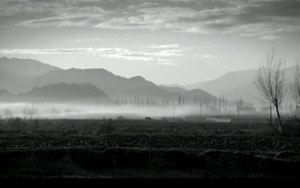
Shanker's been shooting in Ladakh for the last year. Here is his account of shooting for the feature film, Frozen. (no links available yet.)
The first character to be cast was the location. Ladakh is a high-altitude desert, known for its stark, barren landscape that is at its extreme during winter. For the most part of their routine, our characters are cut off, almost quarantined from the pervasive influence of modernization. We were convinced after the first recce that Ladakh had the ideal landscape to depict this physical isolation.The rest of his article here.
While examining the first set of images shot in October and November 2005, we felt, in order to do justice to the title Frozen it was necessary to find the appropriate visual palette. We debated over many colour tones and colour reduction theories, recorded many images on a Nikon D100
digital SLR 6 megapixel camera, to explore the options for manipulation. Eventually, on looking at some lovely black and white pictures from the book ‘Ladakh’ shot by the photographer Prabir C Purkayastha, we began to seriously consider black and white as an option.
The landscape of Ladakh at that time of the year is predominantly barren, stark, in tones of red and brown that appear saturated against a deep blue sky. Even though it was at times minus 15 Celsius outside in the middle of the day, when photographed in colour it appeared like it was summer. The film is set in extreme winter, and the drama played out by our characters is totally devoid of any warmth, reassurance or cheer. Black and white images seemed to illustrate this iciness authentically.
The texture and tonality of black and white, we felt, would make the images associative without the burden of having to create unnecessary elaborate detail. Black and white helped us in visualizing with economy.
Thursday, November 30, 2006
Crustimony Proseedcake
“What does Crustimony Proseedcake mean?” said Pooh. “For I am a Bear of Very Little Brain, and long words bother me.
“It means The Thing To Do.”
“As long as it means that, I don’t mind,” said Pooh humbly.
“Centenary Hall?” I asked the watchman.
He pointed towards what could have been the driveway, or the volleyball field beyond, or a derelict car park.
“Aap meeting ke liye aaye?” he asked. “Hau,” I replied feeling as pleased as I had the first time I said the word when I came back to Hyderabad. Each time I say it, I feel like I’m truly home.
“Meeting Shahjehan Hall mein hai, saab.”
*
The meeting was indeed in Shahjehan Hall, but the name was much grander than the place. Chairs were jostling with tables, which were placed in neat intervals through the not very large hall. Nothing else in the place was as neat; the dias, a good deal higher than the floor of the hall, was filled with broken chairs thrown anyhow. Tattered and faded blue curtains hung limp by the wings; along the walls were portraits of principals past, all of them scratched, peeling or hung askew.
We were in Nizam’s College, in the Assembly Hall. The students had been writing their exams here, but now two people were industriously disarranging the chairs and pushing the tables to the side. Someone else was setting up a mike next to a long table and another flunkey had in his hands a tablecloth of a shade of green rarely seen outside hospitals.
I waited for someone to notice me. One of the two men shifting chairs turned and beamed.
“I hope I’m not too early,” I said.
“My dear young lady, you can never be too early! Have a seat.”
The Poetry Society of Hyderabad was meeting for the six hundredth and something time. Started some time in the thirties, it is one of the oldest poetry societies in the country, one that has met with no break since its inception. It has hosted at various time, Rabindranath Tagore, Sarojini Naidu and god knows who else.
People started to trickle in. In a very little time, I began to realise that my mere presence brought the average age of the gathering down to about 55. The eagerness of the Secretary’s greeting seemed less sinister. I had handed in my form and offered to pay up then and there, but he seemed reluctant to take the money just then.
“You see, we have to put the application up to the Committee, and after they approve you can pay.”
The customary procedure is that one attends three meetings before even asking for an application form. I suppose they need to check if you dribble the tea or sneak a biscuit for later, when the reading gets too much. I thought I was exempt. I had attended Brian Mendonca’s reading in August, and I read in September, for heaven’s sake! But rules are rules, etc, and I submitted happily. I had only a hundred bucks in my purse anyway.
*
I was looking forward to this meeting. Brian’s reading had gone very well. People really seemed to enjoy his stuff. My reading – with two other poets – went off even better. I noticed someone having to stand at the back because there weren’t enough chairs. People clapped after some poems, and I was very gratified by this show of good taste. This evening one Dr. K was going to give a lecture on Modernism. It all seemed very intellectual and I wondered what I’d been doing for three years.
The Irani samosas kept us occupied until Dr. K arrived. He began his lecture with the Romantics. Now, I’ve no wish to diss a man who must have spent a fair amount of time putting the lecture together, but this was incoherent stuff. I thought the talk was supposed to be on Modernism, but he spent more than half his allotted time on Keats and Wordsworth, with no real explanation for why he thought it was important to talk about the Romantics in the context of Modernism.
Also, he seemed to think that we needed to be entertained. While this is not an unreasonable assumption to make when you’re standing in front of a class of undergrads who have to listen to what you are saying, it is insulting to assume that people who turn up voluntarily for your talk have to be tricked into absorbing something of value.
Maybe he thought we were Bears Of Very Little Brain.
So while he waved his hands around like windmills to explain how the daffodils might have looked to Wordsworth, I watched the Secretary trying hard to separate xeroxed copies of poems to distribute.
This caused a bit of a stir. While Dr. K talked, people handed around poems to each other, compared pages to see what was missing from their set, and noisily passed around duplicates to those who didn’t have that particular page.
The inevitable phone rang, of course. This hardly needs to be said anymore. If there is anything that requires a degree of silence, you can be sure that someone will have (a) set their phone to Loud (b) put it in the deepest recesses of their most complicated purse/cargo pants (c) been gifted a phone that very morning, and not know how to turn it off without the help and advice of at least three other people. (3a)This is once they begin to realise that it is their phone that is ringing, and not some unnamed antisocial in the gathering.
*
I have to say, though, that he chose some very good poems.
The Panther – Rilke (he didn't mention who the translator was)
A Carafe, That Is a Blind Glass – Gertrude Stein
The Red Wheel Barrow -- William Carlos Williams
The Steeple Jack – Marianne Moore
Paradoxes and Oxymorons – John Ashbery
And one of my most favourite poems,
The Snow Man – Wallace Stevens.
This is not counting the annoying Daffodils; and To The Skylark, which he tried to quote from memory and at which he failed spectacularly (he said, and I couldn’t believe my ears, “unpremeditated strains”!!!).
But if you left out his closed readings, which were very undergrad, and looked at the poems, you could lose yourself in the poetry. Which was fine by me.
So the next meeting I attend, we will sing rousing Christmas carols as a change from all this high-brow stuff. All this modernism and no rhymes and deliberate confusion. We’ll show ’em all that much joy can had by rhyming ‘holly’ with ‘jolly’ and ‘way’ with ‘sleigh’.
Wednesday, November 29, 2006
In mourning…
…for my VHS tapes.
Nearly twenty years ago, when my favourite video rental place was packing it in to do Satellite TV instead, they sold off their tapes to their favourite customers. Because I was averaging at least two films a day, I was kind of top of their list. And what films they had! For thirty bucks a tape, I staggered out with several Woody Allens, Howard Hawks, Ford, Marx Brothers, Wilder…and the Hitchcocks! I had Rope when the Film Institute didn’t! And Under Capricorn? No? Well, I had that one as well.
But having a VCR is like owning a vintage car: you want it pat it fondly and look at it and croon over it, but you know you can’t really use it in case the whole thing falls apart and then where will you go for spares? The other biggie is keeping VHS tapes free of fungus for over 20 years (the tapes had been rented out for at least a few years before I bought them). So the tape gets fungus, you put it in the VCR and play it, the head gets screwed, you clean the head, watch the film for a few minutes, the head gets screwed, etc. Your life goes into a loop and you begin to feel like Sisyphus.
So last month I went to my friendly neighbourhood and magnanimously offered to sell him my VCR at an absurd price, concealing the while my breaking heart. "Madam, find someone who wants a VCR and give it away to them," he said. He seemed to imply that I might even need to pay someone to take it off my hands. Humph!What did he know. Because I found someone who’d take it, and I didn’t need to pay them to do it.
Yesterday, this person turned up to take the VCR away. In a characteristic burst of generosity, I offered to give him all the tapes as well. I mean, where is he going to get VHS tapes now, what will he do without tapes and how will I watch my tapes without a player?
So I cleared out my shelves. Reap The Wild Wind. I hadn’t seen that since the day I bought it. Or Calamity Jane. And I wish I had known even ten years earlier that this would happen; I’d have converted into VCDs Stagecoach, The Man Who Shot Liberty Valance, High Noon, Red River, Hatari, Bringing Up Baby, Arsenic And Old Lace (I almost kept this one back just so I could look at the title every now and then), A Night At The Opera, A Day At The Races, Sunset Boulevard, Casablanca (at least the last two are replaceable). Hannah And Her Sisters, Play It Again Sam, Manhattan, Bananas, Take The Money And Run.
And where on earth am I going to find again, The Reincarnation Of Peter Proud, or To Chase A Crooked Shadow? Or I Confess (hell, even Under Capricorn). Or To Kill A Mocking Bird.
Sigh……..
I have five tapes left on my shelf, even though I know I’m not going to be able to watch them: The Decalogue, Chinatown, Through A Glass Darkly, Last Year At Marienbad and my diploma film. Except for the last, the others are all originals, nearly brand new and I just didn’t have the heart to part with them.
More than the acute sense of loss, I’m overwhelmed by how we all think our present world seems unchangeable or that our technologies will last forever. The VCR has had a good run, but the LD came and went in the blink of an eye. How long do we imagine DVDs will last? Sure, the image itself might be less corruptible than magnetic tape, but something else will come along that will make one’s collection obsolete and unwatchable.
Maybe one day, some derelict old man will shuffle along an empty playground, stop anyone unwise enough to meet his eye and start reciting screenplays while they look at him slightly pityingly and start edging off to wherever they were going.
“No, wait!” he’ll say, desperately trying to catch them up. “This is really funny. Cary Grant says, ‘Men don’t just get into window seats and die!’ and the aunt says… aren’t you going to stay and listen? This is really funny! She says, ‘Of course not dear. He died first.’ Hey! Wait!”
Or, like a pathetic flasher, he’ll show people a few clips of Gentlemen’s Agreement on Youtube or something. And people will walk away, shocked and shaken, wondering if they ought to report him or just have a stiff drink instead.
Sigh. I want to watch Gentlemen’s Agreement. Or To Have And Have Not. Or Key Largo. Or Philadelphia Story.
More. I want to own all of them. Again.
Bah!